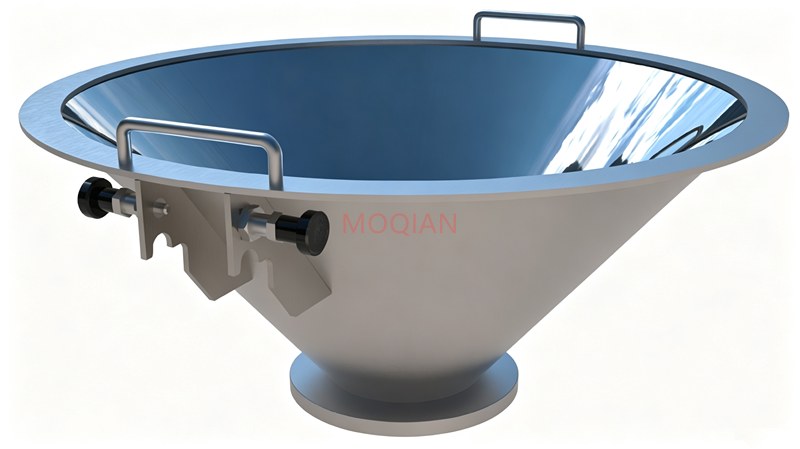
Tablet press feeding components play an important role in pharmaceutical tablet production. They help transfer powder or granules from the hopper to the feeding and die-filling area, supporting stable material flow and consistent production.
Because tablet presses can have different designs and operating requirements, choosing the right feeding components requires more than simply selecting a standard part. Machine compatibility, material, dimensions, surface finish, and cleaning requirements should all be considered.
What Are Tablet Press Feeding Components?
Tablet press feeding components are parts used to store, guide, transfer, or control pharmaceutical materials during tablet production.
Common components include:
- Feeding hoppers
- Square hoppers
- Feeder components
- Tablet dividing wheels
- Guide rails
- Custom feeding parts
Each component has a specific function within the material handling process. The correct combination helps maintain smooth material movement and reliable machine operation.
Key Factors to Consider
1. Material Flow Characteristics
Different powders and granules have different flow characteristics. Some materials flow easily, while others may require carefully designed feeding paths to reduce bridging, accumulation, or inconsistent feeding.
The hopper shape, outlet size, internal structure, and connection design should therefore match the characteristics of the material being processed.
2. Machine Compatibility
A feeding component must fit the specific tablet press or pharmaceutical machine.
Before ordering, it is useful to confirm:
- Machine model
- Overall dimensions
- Mounting dimensions
- Connection interfaces
- Installation position
- Working clearance
Even a small dimensional difference can affect installation and machine operation.
3. Material and Surface Finish
The material of a feeding component should be selected according to the application and working environment.
For pharmaceutical equipment, factors such as corrosion resistance, surface finish, durability, and ease of cleaning are particularly important.
Stainless steel and engineering plastics are commonly used for different types of pharmaceutical machine components, depending on their function and operating conditions.
4. Cleaning and Maintenance
Simple structures, suitable surface finishes, and appropriate connections can make routine cleaning and maintenance more convenient. FDA guidance on pharmaceutical manufacturing equipment also highlights equipment design, cleaning, and maintenance considerations.
A practical component should allow operators to access important areas easily and minimize unnecessary material accumulation.
Simple structures, suitable surface finishes, and appropriate connections can make routine cleaning and maintenance more convenient.
Common Tablet Press Feeding Components
Feeding Hopper
A feeding hopper stores and guides powder or granules toward the feeding area.
Its dimensions and outlet design can be customized according to the machine structure and material requirements.
Square Hopper
Square hoppers are used in various material feeding applications and can be manufactured according to specific machine dimensions.
Customization may include the overall size, outlet dimensions, mounting holes, material, and connection structure.
Tablet Dividing Wheel
A tablet dividing wheel can be used to separate and control the movement of tablets within pharmaceutical machinery.
Its dimensions, tooth or slot configuration, material, and mounting design can be produced according to the application.
Instruction Leaflet Guide Rails
Instruction leaflet guide rails are designed to guide package inserts or instruction leaflets through packaging equipment.
Accurate dimensions and suitable material selection are important for smooth leaflet movement and reliable operation.
Custom Feeding Components
Some machines require non-standard components that are not available as off-the-shelf parts.
Custom components can be manufactured based on:
- Technical drawings
- Existing samples
- Machine models
- Detailed dimensions
- Material requirements
- Application requirements
Standard or Custom Components: Which Should You Choose?
Standard components can be suitable when the machine dimensions and operating requirements match an existing design.
However, custom components may be more appropriate when:
- The original part is discontinued
- A replacement part is difficult to source
- The machine has a special configuration
- Existing components require modification
- Specific materials are required
- Exact dimensions are necessary
Providing a drawing or sample can help the manufacturer understand the required structure and dimensions more accurately.
How to Choose the Right Supplier
When sourcing tablet press feeding components, consider more than the unit price.
Important factors include:
Manufacturing Capability
The supplier should have suitable machining and manufacturing capabilities for the required components.
Dimensional Accuracy
Accurate dimensions are important for components that need to fit existing pharmaceutical machinery.
Material Options
Different applications may require stainless steel, engineering plastics, or other suitable materials.
Customization Capability
A supplier should be able to manufacture components based on drawings, samples, or specific dimensions.
Quality Inspection
Inspection of dimensions, materials, surface finish, and overall workmanship can help ensure consistent product quality.
MOQIAN Custom Tablet Press Feeding Components
MOQIAN provides custom components for pharmaceutical machinery and material handling applications.
Our product range includes feeding hoppers, square hoppers, tablet dividing wheels, instruction leaflet guide rails, and other customized machine components.
We can manufacture components according to your drawings, samples, dimensions, machine models, or specific application requirements.
Whether you need a replacement component or a new custom part, providing detailed technical information can help us evaluate your requirements more efficiently.
Need a Custom Feeding Component?
Have a drawing, sample, or machine model?
Send us your requirements and let us review the component specifications, dimensions, material, and application.
Conclusion
Choosing the right tablet press feeding components requires careful consideration of material flow, machine compatibility, materials, dimensions, cleaning, and maintenance.
For standard applications, suitable off-the-shelf components may be sufficient. For specialized machines or replacement requirements, customized components can provide a more precise fit.
By working with a supplier capable of manufacturing according to drawings, samples, and technical specifications, you can obtain feeding components designed for your specific equipment and application.