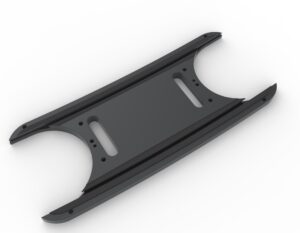
In pharmaceutical manufacturing, machinery components must provide reliable performance, dimensional stability, and consistent operation. Components that guide, support, separate, or transport products are often exposed to continuous movement and friction.
POM Wear Plates are widely used as engineering plastic components in pharmaceutical machinery because of their low friction, good wear resistance, dimensional stability, and suitability for precision-machined parts.
From tablet processing equipment to conveying and feeding systems, POM wear plates can help reduce friction and provide smooth, reliable movement between machine components.
What Are POM Wear Plates?
POM, also known as acetal or polyoxymethylene, is a semi-crystalline engineering thermoplastic with good mechanical strength, wear resistance, sliding properties, and dimensional stability. For more information about POM material properties, see POM Plastic – Polyoxymethylene from Ensinger.
POM wear plates are wear-resistant components manufactured from Polyoxymethylene (POM), an engineering thermoplastic also known as acetal.
POM has a combination of mechanical and tribological properties that makes it suitable for applications involving sliding, guiding, positioning, and repeated mechanical movement.
Depending on the equipment design, POM wear plates can be manufactured in different shapes, thicknesses, hole patterns, and surface configurations.
Typical applications include:
- Sliding and guide surfaces
- Support plates
- Conveyor wear strips
- Machine guide components
- Product transfer components
- Feeding and positioning mechanisms
- Custom wear-resistant machine parts
For pharmaceutical equipment manufacturers, these components can be produced according to specific drawings and dimensional requirements.
Why Use POM Wear Plates in Pharmaceutical Machinery?
Pharmaceutical machinery often operates continuously and requires stable mechanical performance. Selecting the appropriate material for sliding and wear components can therefore be important for equipment reliability.
1. Low Friction
POM has relatively low friction characteristics, making it suitable for components where two surfaces move against each other.
In pharmaceutical machinery, POM wear plates can be used as sliding or guiding components to help maintain smooth movement and reduce unnecessary friction between machine parts.
2. Good Wear Resistance
Wear components are exposed to repeated mechanical movement. Over time, unsuitable materials can experience surface wear, dimensional changes, or premature replacement.
POM provides good wear resistance for many mechanical applications, making it a practical choice for guide plates, wear strips, and other continuously moving components.
3. Dimensional Stability
Precision is important in pharmaceutical machinery.
POM offers good dimensional stability compared with many conventional plastics, helping components maintain their designed geometry during normal operating conditions.
This can be particularly useful for precision-machined components that require consistent clearances and positioning.
4. Good Machinability
POM is relatively easy to machine using conventional CNC machining processes.
This allows manufacturers to produce customized components with:
- Precision holes
- Slots
- Grooves
- Recesses
- Complex profiles
- Tight dimensional requirements
For OEM pharmaceutical machinery manufacturers, this makes POM a flexible material for producing custom wear plates according to engineering drawings.
5. Smooth Surface Characteristics
A smooth and consistent surface can be beneficial for components used in guiding and product-transfer mechanisms.
POM can provide a smooth working surface that supports stable movement in appropriately designed machinery.
Common Applications of POM Wear Plates in Pharmaceutical Equipment
POM wear plates can be used in a variety of pharmaceutical machinery applications.
Tablet Processing Equipment
Tablet manufacturing equipment contains multiple moving and guiding components. POM wear plates can be used in selected areas where low friction and wear resistance are required.
Possible applications include:
- Guide components
- Sliding plates
- Support components
- Product transfer mechanisms
The specific material grade should be selected according to the equipment design and operating conditions.
Feeding and Material Handling Systems
Material feeding systems require stable and controlled movement.
POM wear plates can be incorporated into guide and support structures to help reduce friction between moving components.
They may be used around:
- Feeding mechanisms
- Transfer systems
- Chutes
- Guide rails
- Sliding assemblies
Pharmaceutical Conveyors
Conveyor systems are commonly used for transporting containers, packages, and products through different stages of production.
Wear plates and guide components made from POM can provide a low-friction contact surface for selected conveyor applications.
They can also be machined into customized profiles to match different conveyor designs.
Capsule and Packaging Equipment
Capsule processing and pharmaceutical packaging machines contain numerous precision mechanical components.
POM components can be used for guiding, positioning, and supporting moving parts where the material’s mechanical properties are appropriate.
POM Wear Plate Manufacturing Options
The design of a POM wear plate depends on the machine structure and application requirements.
At MOQIAN, customized POM wear plates can be manufactured according to customer drawings, dimensions, or samples.
Typical customization options include:
Material:
POM / Acetal
Shape:
Flat plates, strips, guide plates, blocks, and custom profiles
Machining:
CNC milling, drilling, cutting, slotting, and other precision machining operations
Dimensions:
Customized according to engineering drawings
Surface:
Machined or finished according to application requirements
For OEM projects, providing a technical drawing with dimensions and tolerances can help manufacturers evaluate the component and select an appropriate manufacturing process.
How to Choose the Right POM Wear Plate
Choosing a POM wear plate should be based on the actual operating conditions of the equipment rather than material name alone.
Consider the following factors:
Operating Temperature
Temperature affects the mechanical performance and dimensional stability of engineering plastics.
The expected operating temperature should therefore be considered when selecting the material grade.
Load and Contact Pressure
The applied load and contact pressure can affect wear performance.
Higher loads may require a different material grade, geometry, or component design.
Sliding Speed
The relative movement between contacting surfaces is another important factor.
High-speed applications may require additional consideration of friction, heat generation, and wear.
Chemical Environment
Pharmaceutical equipment may be exposed to cleaning agents, process materials, lubricants, or other chemicals.
The compatibility of the selected POM material with the actual operating environment should be evaluated before production.
Dimensional Requirements
For precision pharmaceutical machinery, dimensional tolerances and installation clearances should be clearly specified.
Providing a technical drawing can help ensure that the finished component matches the original equipment design.
POM Wear Plates vs. Metal Wear Components
POM and metal have different properties and should be selected according to the application.
POM offers advantages such as low weight, low friction, and easy machining, while metals may provide higher strength and temperature resistance in demanding mechanical environments.
For applications where low-friction sliding and reduced component weight are important, POM can be a practical alternative to certain metal components.
However, material selection should always consider load, temperature, chemical exposure, wear conditions, and equipment requirements.
Custom POM Wear Plates for Pharmaceutical Machinery
Standard wear plates may not always match the geometry of specialized pharmaceutical equipment.
Custom machining allows the component to be manufactured according to the customer’s specific requirements.
MOQIAN provides customized engineering plastic components for industrial equipment manufacturers, including POM wear plates and other precision-machined parts.
Customers can provide:
- 2D drawings
- 3D CAD files
- Existing component samples
- Dimensions and tolerances
- Material requirements
- Application information
Based on these details, the manufacturing process and material specification can be evaluated before production.
Conclusion
POM Wear Plates are useful engineering plastic components for pharmaceutical machinery where low friction, wear resistance, dimensional stability, and precision machining are required.
They can be applied to selected areas of tablet processing equipment, feeding systems, conveyors, packaging machines, and other pharmaceutical equipment.
For OEM and custom machinery projects, the correct material grade, dimensions, tolerances, and operating conditions should be considered before production.
If you need customized POM wear plates for pharmaceutical machinery, MOQIAN can manufacture components according to your drawings, samples, and technical requirements.
Contact MOQIAN to discuss your custom POM wear plate project.